
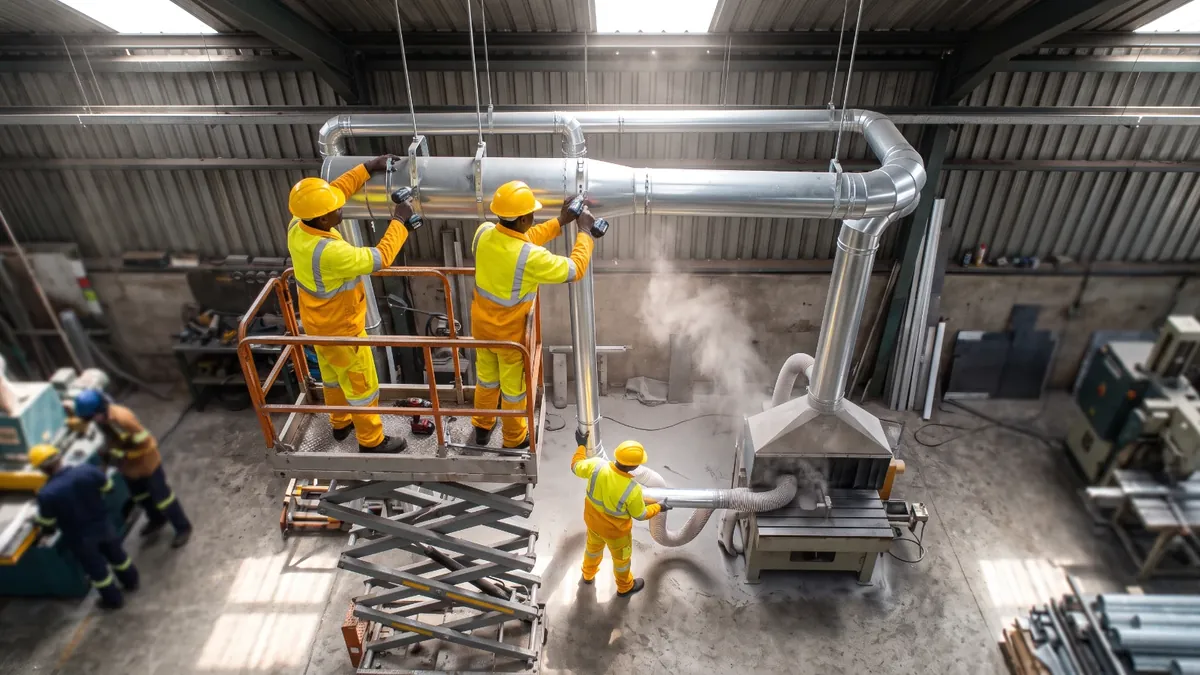
Dust Collector Repairs South Africa covers a unit that has stopped pulling, is leaking dust or has tripped and will not restart. Most of it is one of four things: blinded filters, a failed fan or motor, a cleaning system that is not firing, or a duct blockage that is not the unit at all. Say what it is doing and get repair quotations to compare.
Super easy & fast
- Know what a filter change or a fan repair should cost, so you never pay too much.
- Send the same fault details to several extraction companies, and quotes come back fast.
- From LEADERR APPROVED providers, vetted and backed by many verified 5-star reviews. Peace of mind that the fault is diagnosed before parts are ordered.
Say what the unit is doing, and get repair quotes.
Get the Best QuoteDust Collector Repairs Prices
Ballpark figures so you can check a quotation.
| Item | Ballpark price |
|---|---|
| Call-out and fault diagnosis | R1,200 - R4,500 |
| Filter bag replacement, per bag fitted | R350 - R1,400 |
| Cartridge filter replacement, each fitted | R1,800 - R6,500 |
| Pulse valve or diaphragm replacement, each | R900 - R3,500 |
| Fan bearing replacement | R4,500 - R22,000 |
| Impeller clean and balance | R6,000 - R30,000 |
| Motor rewind or replacement | R6,500 - R45,000 |
| Annual service and filter clean | R4,000 - R20,000 |
Prices JUST UPDATED. Ballpark figures, rounded, excluding VAT. They reflect typical South African dust extraction, fume and ventilation rates. They are not our prices or quotations, and no provider is bound by them. An extraction system is quoted on the AIRFLOW IT HAS TO MOVE and the machines running at the same time, not on the floor area of the building, so confirm what each quotation includes, such as the airflow it is sized for, the ducting, the hoods at each machine and the electrical connection.
What Usually Fails
- Blinded filters. The commonest fault by far, and often the cheapest to put right.
- The cleaning system. Pulse valves, timers and shaker mechanisms stop firing quietly.
- The fan. Worn bearings, an out of balance impeller or a slipping belt.
- The motor. Tripping on overload, usually a symptom rather than the cause.
- Leaks and splits. Torn bags, cracked hoppers and perished door seals that lose suction.
Where Quotes Differ Most
- Whether it is diagnosed first. A call-out and report, or parts quoted off a description.
- Filter count and type. Bags and cartridges differ in price and in how many there are.
- Whether the fan comes out. A bearing change on site is not a workshop strip and balance.
- Access to the unit. A roof or platform unit needs scaffold or a cherry picker.
- How urgent it is. A standing workshop pays for an after hours or weekend call-out.
How the Work Runs on Site
- The unit is isolated and opened. Power locked off before anything is touched.
- Filters and seals are inspected. The state of the filter usually names the fault.
- The cleaning system is tested. Valves fired one by one, with the air supply checked.
- The fan is checked by hand. Play in the bearings, belt tension and impeller build-up.
- Airflow is measured after the repair. Compared with what it should be, not with what it was.
Get a price for your own fault rather than a range.
Get the Best QuoteWhat Affects the Price
- How many filters there are. A twelve bag unit and a ninety bag unit are different jobs.
- Whether the parts are standard. An older or imported unit can mean a lead time and a premium.
- Where the unit stands. Height and access decide whether a platform is needed.
- How bad the blinding is. Cleanable filters cost a service, blinded ones cost a set.
- Whether the fault is downstream. A blocked duct reads as a weak collector until it is checked.
- How quickly you need it. Same day and after hours carry their own rates.
What to Include in Your Request
- The address. Suburb and town, so a company knows whether they work there.
- The make and size. Off the unit plate if you can reach it, with the motor rating.
- What it is doing. Weak suction, dust from the clean side, tripping or not starting.
- When it started. Gradually over months, or suddenly on one shift.
- The filter type. Bags or cartridges, and roughly how many.
- How urgent it is. Whether the shop is standing still while it waits.
Before You Appoint a Repairer
- Ask for the fault in writing. What failed and why, not just what will be replaced.
- Ask whether the duct was checked. A blockage downstream fakes a collector fault.
- Ask what the filters cost to replace. Per bag or per cartridge, and how many the unit takes.
- Ask about the cleaning system. A unit whose pulse valves are dead will blind again in weeks.
- Ask for measured airflow afterwards. The proof the repair did what it was sold as.
- Ask what the guarantee covers. Labour, parts, and whether filters are excluded.
Dust Collector Repairs FAQs
Why has my dust collector lost suction?
Blinded filters first, in most cases, then a cleaning system that has stopped firing, then a blocked duct or an open blast gate somewhere else in the shop. A worn fan or a slipping belt comes further down the list. A diagnosis is worth more than a parts quote.
How often should filters be replaced?
It depends on the dust and on whether the cleaning system works. Bags in a well cleaned unit on wood dust commonly run two to five years; fine, damp or sticky dust can blind a set in months. A filter being cleaned properly is what decides it.
Why is dust coming out of the clean side?
A torn bag, a cartridge that has split, or a seal on the tube sheet that has perished. It should be looked at quickly, because the dust is going through the fan and into the building rather than into the hopper.
Is it worth repairing an old collector?
Often yes, if the shell and the hopper are sound, because the filters and the fan are what wear. Where the unit was always undersized for the machines it serves, a repair restores a system that never worked properly, and refurbishment or replacement is the better question.
How long does a repair take?
A filter change is usually a day, and most are planned for a weekend or a shutdown so the shop is not standing. A fan rebuild that has to go to a workshop is commonly three days to two weeks, depending on the balance work.
Repairs are the service most owners of an existing system come to Dust Extraction South Africa for, and comparing two diagnoses is worth more than comparing two parts lists.
Related Services
Get the Best Quote, Fast
Client Reviews
Powered by leaderr