
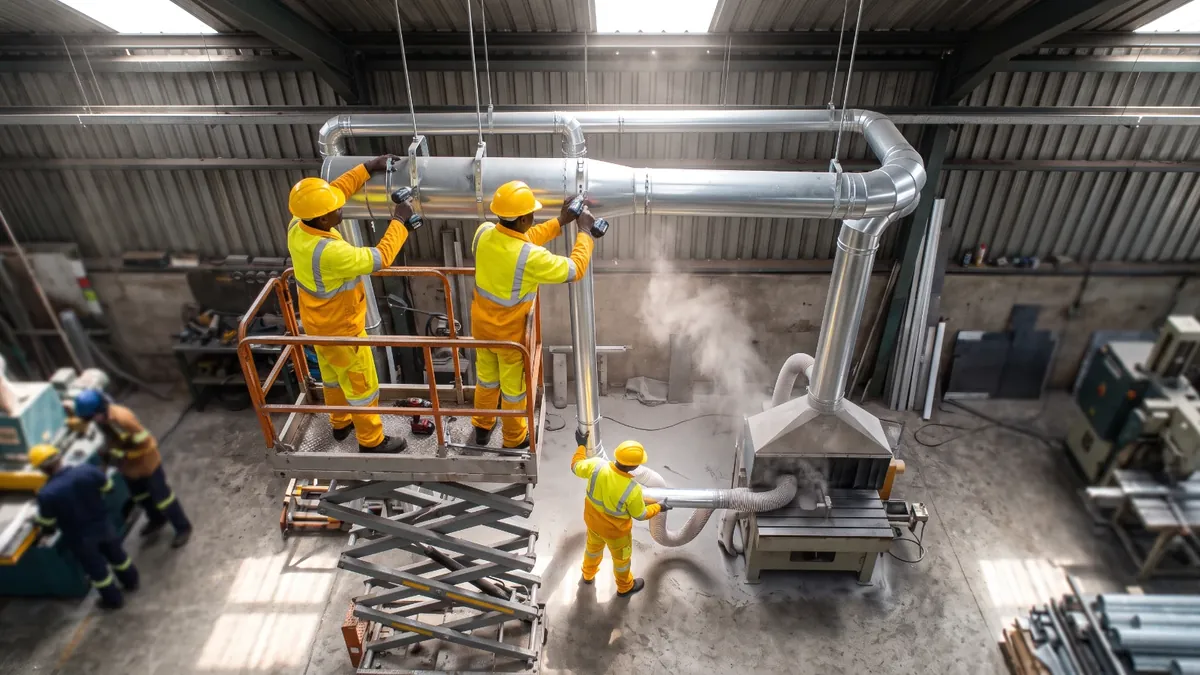
Dust Cyclones South Africa drop the heavy fraction out of the airstream before it reaches a filter, using nothing but the spin. On chips and shavings a cyclone does most of the work on its own. Ahead of a bag or cartridge unit it is what keeps the filter alive. Say whether you are moving chips or fine dust and get quotations to compare.
Super easy & fast
- Know what a cyclone should cost installed, so you never pay too much.
- Send the same airflow details to several extraction companies, and quotes come back fast.
- From LEADERR APPROVED providers, vetted and backed by many verified 5-star reviews. Peace of mind that the cyclone is sized to your airflow and not fitted by eye.
Say what you are moving, and get cyclone quotes.
Get the Best QuoteDust Cyclones Prices
Ballpark figures so you can check a quotation.
| Item | Ballpark price |
|---|---|
| Small workshop cyclone, supplied | R12,000 - R45,000 |
| Medium cyclone, supplied | R45,000 - R180,000 |
| Large industrial cyclone, supplied | R180,000 - R900,000 |
| Rotary airlock valve, supplied | R18,000 - R95,000 |
| Support frame or platform | R15,000 - R160,000 |
| Installation and duct connection | R10,000 - R90,000 |
| Abrasion liners or thickened cone | R8,000 - R70,000 |
| Cone or body repair on site | R6,000 - R45,000 |
Prices JUST UPDATED. Ballpark figures, rounded, excluding VAT. They reflect typical South African dust extraction, fume and ventilation rates. They are not our prices or quotations, and no provider is bound by them. An extraction system is quoted on the AIRFLOW IT HAS TO MOVE and the machines running at the same time, not on the floor area of the building, so confirm what each quotation includes, such as the airflow it is sized for, the ducting, the hoods at each machine and the electrical connection.
What a Cyclone Quote Covers
- The cyclone body. Diameter and cone length, sized to the airflow it will see.
- The inlet. Where the duct enters, which sets how well it separates.
- The discharge. Airlock, bin, bag or a screw out to a silo.
- The support. A frame or legs, and the platform if it is up in the air.
- Wear protection. Thicker plate or liners where the dust is abrasive.
Where Quotes Differ Most
- Airflow. A cyclone only separates properly within the band it was sized for.
- Plate thickness. Abrasive dust eats a thin cone, and the repair costs more than the steel.
- Whether an airlock is fitted. Without one the cyclone pulls air back up and stops separating.
- Where it stands. Ground level, on a frame or on the roof are three installations.
- Whether a filter follows. A cyclone alone discharges the fines, which is not always allowed.
How the Work Runs on Site
- The airflow is confirmed first. The cyclone is sized to it, not to the duct diameter.
- The frame or platform goes up. With safe access to the airlock for maintenance.
- The cyclone is lifted and bolted. Usually a crane morning and the noisiest part.
- Duct, airlock and bin are connected. The airlock is wired and interlocked with the fan.
- Separation is checked under load. Fines carried over mean the sizing is wrong.
Get a price for your own setup rather than a range.
Get the Best QuoteWhat Affects the Price
- The airflow. A cyclone sized for the wrong airflow separates badly at any price.
- What is being carried. Chips drop out easily, flour fine dust mostly does not.
- How abrasive the dust is. Sand, grit and hardwood decide the plate thickness.
- Whether an airlock is needed. Continuous discharge needs one, a drop bin may not.
- The height it goes to. Roof level means a platform, a ladder and a crane.
- Whether a filter follows it. A cyclone as a pre-cleaner is a different duty to a standalone.
What to Include in Your Request
- The address. Suburb and town, so a company knows whether they work there.
- The airflow. If you have it, or the fan motor rating and the duct diameter.
- What is being carried. Chips, shavings, sanding dust, grit or a mix.
- Where it will stand. Inside, outside, ground level or on a frame.
- What follows it. A bag or cartridge filter, or nothing.
- How the dust is removed. Bin, bag, airlock or a conveyor out.
Before You Appoint a Supplier
- Ask what airflow it is sized for. A cyclone has a band, not a rating.
- Ask what the plate thickness is. On abrasive dust it is the whole life of the unit.
- Ask whether an airlock is included. It is the item most often left out and most often needed.
- Ask what happens to the fines. A cyclone alone does not catch them.
- Ask about access. The airlock and the cone need reaching without scaffold every time.
- Ask for the separation expected. A number for your dust, not a brochure figure.
Dust Cyclones FAQs
What does a dust cyclone cost in South Africa?
A small workshop cyclone is commonly R12,000 to R45,000 supplied, a medium one R45,000 to R180,000, and large industrial units from about R180,000 upward. A rotary airlock and a support frame are usually quoted separately and both are easy to overlook.
Do I still need a filter after a cyclone?
Usually. A cyclone drops the heavy fraction but carries the fines over, and those fines are the part that is a problem indoors and often the part that is regulated outdoors. On chips alone, discharging into a bin outside, some shops run a cyclone on its own.
Why does my cyclone not separate properly?
Most often it is running at the wrong airflow, because a cyclone only works within the band it was sized for. After that: no airlock, so air is drawn back up the discharge, a worn cone, or a leak on the bin lid.
Does a cyclone save on filters?
Substantially, which is its main argument as a pre-cleaner. Taking the heavy fraction out ahead of the filter means the bags or cartridges see a fraction of the load, and they last longer and clean better for it.
What is an airlock for?
It lets dust out of the bottom of the cyclone without letting air back in. Without one the fan pulls air up through the discharge, the spin collapses and the cyclone stops separating, which is why a bin that is only bolted on often disappoints.
A cyclone is nearly always part of a larger installation on Dust Extraction South Africa so it is worth getting the filter and the ducting priced with it.
Related Services
Get the Best Quote, Fast
Client Reviews
Powered by leaderr