
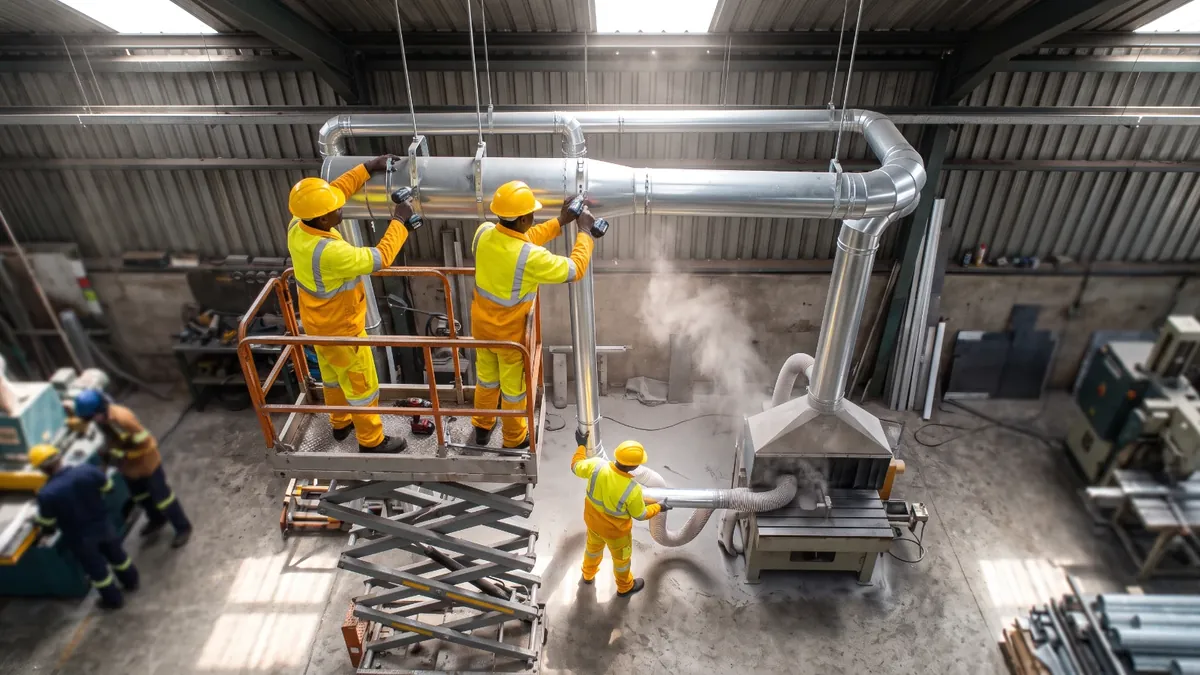
Extractor Fan Installation South Africa covers the fan in a bathroom, a kitchen, a toilet or a workshop, and the duct that gets the air outside. Most of the price is not the fan: it is the core through the wall, the ducting to the outside and the electrical connection. Say where it has to vent and what room it serves, and get quotations to compare.
Super easy & fast
- Know what a fan should cost fitted, so you never pay too much.
- Send the same room details to several extraction companies, and quotes come back fast.
- From LEADERR APPROVED providers, vetted and backed by many verified 5-star reviews. Peace of mind that the fan is vented outside rather than into the ceiling.
Say where the fan must vent, and get installation quotes.
Get the Best QuoteExtractor Fan Installation Prices
Ballpark figures so you can check a quotation.
| Item | Ballpark price |
|---|---|
| Bathroom wall fan, supplied and fitted | R1,400 - R4,500 |
| Ceiling fan with short duct run | R2,200 - R7,500 |
| Inline fan in the ceiling void | R3,500 - R12,000 |
| Roof mounted extractor, fitted | R4,500 - R18,000 |
| Core drill through brick, each | R650 - R2,200 |
| Ducting and external cowl | R750 - R3,500 |
| New switched circuit or timer | R1,200 - R5,500 |
| Industrial wall fan, fitted | R6,500 - R45,000 |
Prices JUST UPDATED. Ballpark figures, rounded, excluding VAT. They reflect typical South African dust extraction, fume and ventilation rates. They are not our prices or quotations, and no provider is bound by them. An extraction system is quoted on the AIRFLOW IT HAS TO MOVE and the machines running at the same time, not on the floor area of the building, so confirm what each quotation includes, such as the airflow it is sized for, the ducting, the hoods at each machine and the electrical connection.
What an Installation Quote Covers
- The fan. Wall, ceiling, inline or roof mounted, sized to the room.
- The core or opening. Cut through brick, board or a roof sheet and made good.
- The duct to outside. Flexible or rigid, with a cowl or a louvre on the end.
- The electrical connection. Switched, on the light, or with a timer or humidistat.
- Making good. Plaster, paint and sealing, which is often quoted separately.
Where Quotes Differ Most
- Where it vents. A nearby outside wall is a different job to a roof run.
- The wall. Face brick, double skin and concrete each change the coring.
- Whether wiring exists. A new circuit or a switch drop is most of the cost on some jobs.
- Fan type. A basic axial fan against an inline or a silent unit.
- Access. Ceiling void, roof pitch and whether scaffold is needed.
How the Work Runs on Site
- The vent route is chosen. The shortest line to outside air, not into a ceiling void.
- The opening is cored. Dust sheeted, and the dustiest half hour of the job.
- The duct is run and sealed. With a fall away from the fan so condensate runs out.
- The fan is fitted and wired. With its switch, timer or humidistat set.
- It is tested and made good. Airflow felt at the outside cowl, not just at the grille.
Get a price for your own room rather than a range.
Get the Best QuoteWhat Affects the Price
- How far it is to outside. A metre through a wall against ten metres to a roof.
- What the wall is. Double brick and concrete are slower to core than board.
- Whether there is power there. A new circuit can cost more than the fan.
- The room. A shower room needs more airflow than a toilet does.
- Fan type. Silent and inline fans cost more and are worth it over a bedroom.
- Making good. Plaster and paint afterwards, which not every quote carries.
What to Include in Your Request
- The address. Suburb and town, so an installer knows whether they work there.
- Which room. Bathroom, kitchen, toilet, laundry or workshop.
- Where it can vent. An outside wall nearby, or only through the roof.
- The wall. Brick, double skin, concrete or drywall.
- Whether power is there. An existing fan, a light circuit, or nothing.
- Whether it is a replacement. An existing fan being swapped is a different job.
Before You Appoint an Installer
- Ask where it vents to. Outside air, not into the ceiling or the roof space.
- Ask what airflow the fan gives. Matched to the room size rather than to the opening.
- Ask who does the electrical work. And whether a certificate is issued for a new circuit.
- Ask whether making good is in it. Coring makes a mess and the repair is a real cost.
- Ask about the duct. Rigid where it can be, and sealed, so damp air leaves the house.
- Ask about noise. Over a bedroom or in a quiet office it is worth paying for.
Extractor Fan Installation FAQs
What does it cost to install an extractor fan?
A bathroom wall fan supplied and fitted is commonly R1,400 to R4,500. A ceiling fan with a duct run is R2,200 to R7,500, an inline fan R3,500 to R12,000, and a roof mounted unit R4,500 to R18,000, before any new wiring.
Can an extractor fan vent into the roof space?
It should not. Warm damp air in a roof space is how ceilings stain and timber rots, and it moves the problem rather than solving it. The duct should run to an outside wall, a roof cowl or a soffit vent with a proper outlet.
What size extractor fan do I need?
It follows the room volume and how the room is used: a shower room needs more air changes than a toilet. An installer sizes it from the room rather than from the hole in the wall, and a fan that is too small runs longer without ever clearing the steam.
Do I need an electrician?
For a straight swap on an existing fan point, often not. For a new circuit, a switch drop or anything on a new build, yes, and you should expect a certificate covering the new work.
Why is my bathroom still steamy with a fan running?
Usually the fan is too small, the duct is long, kinked or uninsulated, or there is nowhere for replacement air to come in. A door with no gap under it will starve a fan completely, whatever its rating.
Fan work is usually priced by the same companies that handle extraction on Dust Extraction South Africa so it is worth asking for both in one request.
Related Services
Get the Best Quote, Fast
Client Reviews
Powered by leaderr