Fume Extraction South Africa is the air that is not dust: welding fume, soldering smoke, chemical vapour and the haze off a process. It is caught at the source with an arm, a bench or a hood, because fume that reaches the roof has already been breathed. Say what makes it and how many stations there are, and get quotations to compare.
Super easy & fast
- Know what an extraction arm should cost installed, so you never pay too much.
- Send the same station details to several extraction companies, and quotes come back fast.
- From LEADERR APPROVED providers, vetted and backed by many verified 5-star reviews. Peace of mind that the capture is at the source rather than at the roof.
Say what makes the fume, and get extraction quotes.
Get the Best QuoteFume Extraction Prices
Ballpark figures so you can check a quotation.
| Item | Ballpark price |
|---|---|
| Extraction arm, 2m to 3m, supplied | R9,000 - R32,000 |
| Extraction arm, 4m, supplied | R18,000 - R55,000 |
| Portable welding fume unit with arm | R28,000 - R110,000 |
| Downdraught bench, small | R35,000 - R140,000 |
| Central fume system, four to eight stations | R120,000 - R550,000 |
| On-torch extraction kit, per station | R6,500 - R28,000 |
| Filter cartridge replacement, each fitted | R2,000 - R7,500 |
| Installation, per station | R4,500 - R22,000 |
Prices JUST UPDATED. Ballpark figures, rounded, excluding VAT. They reflect typical South African dust extraction, fume and ventilation rates. They are not our prices or quotations, and no provider is bound by them. An extraction system is quoted on the AIRFLOW IT HAS TO MOVE and the machines running at the same time, not on the floor area of the building, so confirm what each quotation includes, such as the airflow it is sized for, the ducting, the hoods at each machine and the electrical connection.
What a Fume Quote Covers
- Capture at the source. An arm, a bench, a hood or an on-torch extractor at each station.
- The filter. Cartridge, electrostatic or carbon, chosen for what is in the fume.
- The fan. Sized for the stations that run together, not for all of them.
- Ducting and dampers. So an unused station is not stealing air from a busy one.
- Discharge or return. Outside, or filtered back in, which needs a higher grade.
Where Quotes Differ Most
- What is in the fume. Mild steel, stainless, galvanised and coated metal differ sharply.
- Arm reach. Two, three and four metre arms are different prices and different mounts.
- Portable or fixed. A mobile unit per bay against a central system with ducting.
- Filter grade. Returning air into the shop raises what the filter has to do.
- How many run at once. The number of simultaneous stations sets the fan, and the fan sets the bill.
How the Work Runs on Site
- The stations are walked first. Where the work sits in practice, not where the bench is drawn.
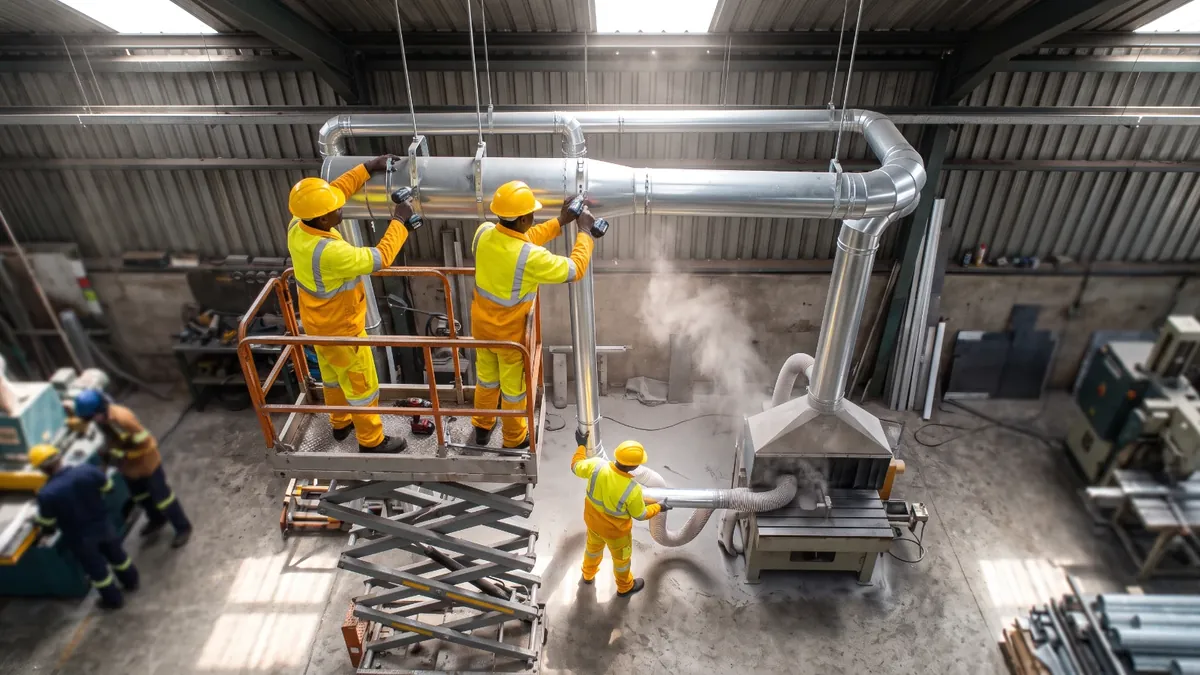
- Mounts and arms go up. On a wall, a post or the bench, with reach checked at the weld.
- The unit is set and wired. With the fan sized for the simultaneous stations.
- Ducting and dampers are balanced. So capture is the same at the far station as the near one.
- Capture is checked at the arc. Measured at the hood, which is the only place it counts.
Get a price for your own stations rather than a range.
Get the Best QuoteWhat Affects the Price
- What is being welded. Stainless and galvanised need more capture and a better filter.
- How many stations. Each adds an arm, a mount and airflow to the fan.
- How many run together. The fan is sized for this, and it is the biggest single lever.
- Arm reach. Longer arms cost more and need a stronger mount.
- Whether the air returns. Filtered return needs a higher grade and often a carbon stage.
- The building. Roof height and bay layout decide how much ducting there is.
What to Include in Your Request
- The address. Suburb and town, so a company knows whether they work there.
- What makes the fume. Welding and the process, soldering, grinding or a chemical.
- The metal. Mild steel, stainless, galvanised, aluminium or coated.
- How many stations. How many exist and how many run at the same time.
- The bay layout. Bench, floor, inside a jig, or a vessel someone climbs into.
- Whether the air returns. Back into the shop or discharged outside.
Before You Appoint a Supplier
- Ask where the capture is measured. At the arc, not at the fan.
- Ask about the metal. A quote that does not ask what you weld has not sized the filter.
- Ask how many stations at once. A fan sized for all of them is money spent for nothing.
- Ask what the filter costs to replace. Fume cartridges are a regular cost, not a one-off.
- Ask about returned air. What grade, and what happens if the filter is not changed.
- Ask about arm reach in use. An arm that just reaches on paper does not reach in a jig.
Fume Extraction FAQs
What does welding fume extraction cost?
An extraction arm is commonly R9,000 to R32,000 supplied at two to three metres, with installation from about R4,500 a station. A portable unit with its own arm runs R28,000 to R110,000, and a central system for four to eight stations R120,000 to R550,000.
Is an extraction arm better than general ventilation?
For fume, yes. Capture at the source takes the fume before it reaches anyone, while general ventilation dilutes it after the welder has already breathed it. Roof extraction has its place for heat, but it is not a substitute.
Does stainless need different extraction?
It needs better capture and a better filter, because the fume from stainless and from galvanised or coated steel is more hazardous than mild steel fume. Tell the supplier what you weld, because it changes both the filter grade and whether air may be returned.
Can fume be filtered and returned to the workshop?
Often, and it saves heating a building you have just emptied of air. It needs a higher filter grade, frequently a carbon stage, and the filter has to be changed on schedule. What is permitted depends on the fume and on your own workplace rules.
What is on-torch extraction?
Extraction built into the welding torch itself, which captures at the arc and needs far less airflow than an arm. It suits long runs of repetitive welding and is less popular where welders find it alters the handling of the torch.
Fume work is often quoted alongside dust extraction on Dust Extraction South Africa because the same company usually installs both.
Related Services
Get the Best Quote, Fast
Client Reviews
Powered by leaderr